Effectiveness of Multilevel Risk Management Emergency Response Activities To Ensure Free Chlorine Residual in Household Drinking Water in Southern Syria
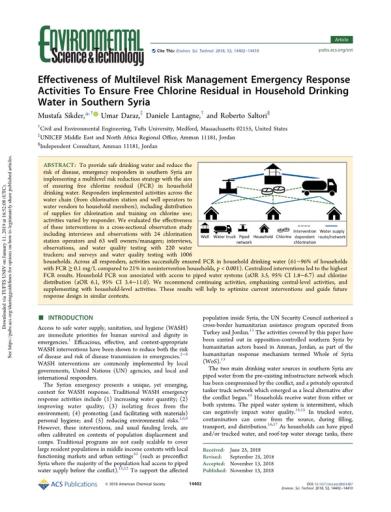
Emergency responders in southern Syria worked across the water chain, from chlorination station and well operators to water truckers and households, to make sure household drinking water contained free chlorine residual (FCR). This study evaluated those activities through interviews, observations and water testing with operators, 220 water truckers and 1,006 households.
The activities worked: 61–96% of households had FCR of at least 0.1 mg/L, compared with 21% of households without the interventions. Centralized interventions gave the best results, and household FCR was linked to access to piped water and to chlorine distribution. The authors recommend continuing the activities, emphasizing central-level work supplemented by household-level activities.
Sikder, Daraz, Lantagne and Saltori. Environmental Science & Technology, 52(24), 2018.
Language:
English
Topics
Need help?
Can’t find what you need? Have more questions about a topic? Need advice on how to use a resource? Chat with a CAWST advisor.
Contact us