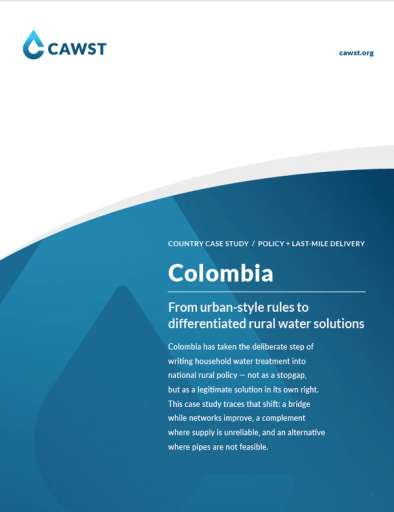
Colombia Case Study: Household Water Treatment in National Policy
Colombia is one of the few countries to have written household water treatment directly into national rural-water policy — not as a stopgap, but as a permanent, regulated option for places piped systems may never reach. This case study traces the country's policy shift from 2007 to 2018, examines pilot-study evidence on water quality outcomes, and identifies where the framework still falls short: no dedicated national funding line, and adoption that depends heavily on household trust and correct maintenance.
Includes the full case study and a one-page policy summary for quick reference.
Colombia Case Study: Household Water Treatment in National Policy
Colombia is one of the few countries to have written household water treatment directly into national rural-water policy — not as a stopgap, but as a permanent, regulated option for places piped systems may never reach. This case study traces the country's policy shift from 2007 to 2018, examines pilot-study evidence on water quality outcomes, and identifies where the framework still falls short: no dedicated national funding line, and adoption that depends heavily on household trust and correct maintenance.
Includes the full case study and a one-page policy summary for quick reference.
Language:
English
Format:
Adobe PDF
Supporting resources
Collections
Duration
10 min
Need help?
Can’t find what you need? Have more questions about a topic? Need advice on how to use a resource? Chat with a CAWST advisor.
Contact usAbout CAWST
CAWST is a Canadian charity and licensed engineering firm. We address the global need for safe drinking water and sanitation by building local knowledge and skills on household solutions people can implement themselves.