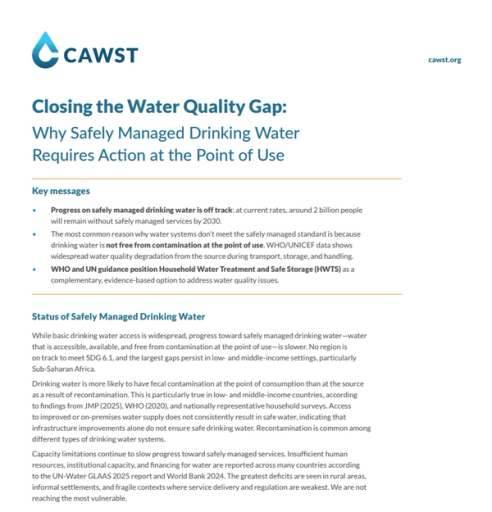
One-Page Summary: The Case for Household Water Treatment
Recent reports from the World Health Organization (WHO), the WHO-UNICEF Joint Monitoring Programme (JMP), and United Nations (UN) Water show that safely managed drinking water is not on track globally to achieve Sustainable Development Goal (SDG) 6.1: universal access to safely managed drinking water.
One-Page Summary: The Case for Household Water Treatment
Recent reports from the World Health Organization (WHO), the WHO-UNICEF Joint Monitoring Programme (JMP), and United Nations (UN) Water show that safely managed drinking water is not on track globally to achieve Sustainable Development Goal (SDG) 6.1: universal access to safely managed drinking water.
Format:
Adobe PDF
Select a language
Need help?
Can’t find what you need? Have more questions about a topic? Need advice on how to use a resource? Chat with a CAWST advisor.
Contact usAbout CAWST
CAWST is a Canadian charity and licensed engineering firm. We address the global need for safe drinking water and sanitation by building local knowledge and skills on household solutions people can implement themselves.