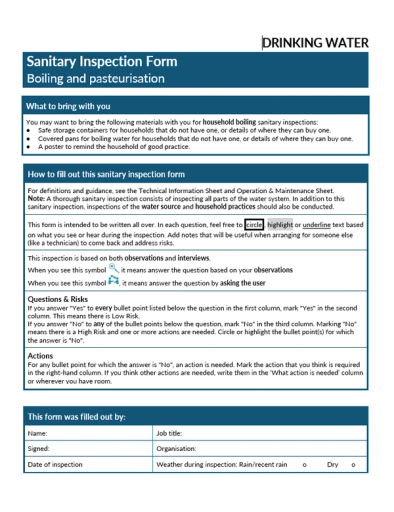
Sanitary Inspection Form: Boiling and Pasteurisation
This form is a field tool used to assess the practice of boiling and condition of boiling equipment. It helps inspectors identify technical and behavioral risks that could affect water quality through a mix of visual checks and household interview questions. The form is useful during routine monitoring visits, follow-up inspections, and technician training, allowing users to record issues and note actions taken. The form functions as a structured, practical tool for ensuring households can safely boil or pasteurize water, identifying gaps in equipment or knowledge, and supporting behavior change that reduces the risk of waterborne disease.
For definitions and guidance, see the Technical Information Fact Sheet
Note: A thorough sanitary inspection consists of inspecting all parts of the water system. In addition to this sanitary inspection, inspections of the water source and household practices should also be conducted. The World Health Organization (WHO) has developed sanitary inspection packages for a range of small water supply scenarios, visit their website to download the packages. Please note that the format of the WHO sanitary inspection forms differs from the CAWST ones.
Sanitary Inspection Form: Boiling and Pasteurisation
This form is a field tool used to assess the practice of boiling and condition of boiling equipment. It helps inspectors identify technical and behavioral risks that could affect water quality through a mix of visual checks and household interview questions. The form is useful during routine monitoring visits, follow-up inspections, and technician training, allowing users to record issues and note actions taken. The form functions as a structured, practical tool for ensuring households can safely boil or pasteurize water, identifying gaps in equipment or knowledge, and supporting behavior change that reduces the risk of waterborne disease.
For definitions and guidance, see the Technical Information Fact Sheet
Note: A thorough sanitary inspection consists of inspecting all parts of the water system. In addition to this sanitary inspection, inspections of the water source and household practices should also be conducted. The World Health Organization (WHO) has developed sanitary inspection packages for a range of small water supply scenarios, visit their website to download the packages. Please note that the format of the WHO sanitary inspection forms differs from the CAWST ones.
Language:
English
Format:
Microsoft Word Document
Need help?
Can’t find what you need? Have more questions about a topic? Need advice on how to use a resource? Chat with a CAWST advisor.
Contact usAbout CAWST
CAWST is a Canadian charity and licensed engineering firm. We address the global need for safe drinking water and sanitation by building local knowledge and skills on household solutions people can implement themselves.