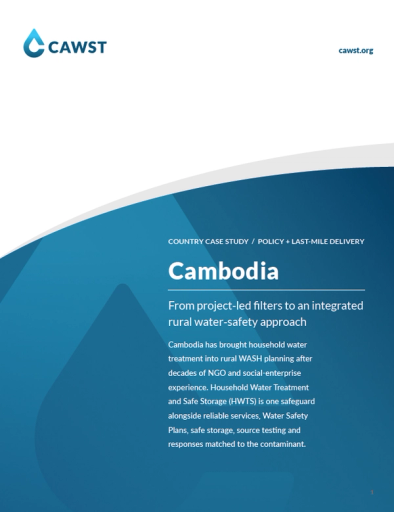
Cambodia Case Study: Household Water Treatment in National Policy
Cambodia has moved from mainly NGO-led household water treatment toward a national plan that treats different contaminants differently — matching ceramic and biosand filters to microbial risk, and specialized arsenic filters to groundwater contamination in the Mekong floodplain. This case study draws on randomized and cluster-randomized trials, Cambodia's strongest evidence base among the three countries in this series, while showing where self-reported use overstates actual practice.
Includes the full case study and a one-page policy summary for quick reference.
Cambodia Case Study: Household Water Treatment in National Policy
Cambodia has moved from mainly NGO-led household water treatment toward a national plan that treats different contaminants differently — matching ceramic and biosand filters to microbial risk, and specialized arsenic filters to groundwater contamination in the Mekong floodplain. This case study draws on randomized and cluster-randomized trials, Cambodia's strongest evidence base among the three countries in this series, while showing where self-reported use overstates actual practice.
Includes the full case study and a one-page policy summary for quick reference.
Language:
English
Format:
Adobe PDF
Supporting resources
Collections
Duration
10 min
Need help?
Can’t find what you need? Have more questions about a topic? Need advice on how to use a resource? Chat with a CAWST advisor.
Contact usAbout CAWST
CAWST is a Canadian charity and licensed engineering firm. We address the global need for safe drinking water and sanitation by building local knowledge and skills on household solutions people can implement themselves.