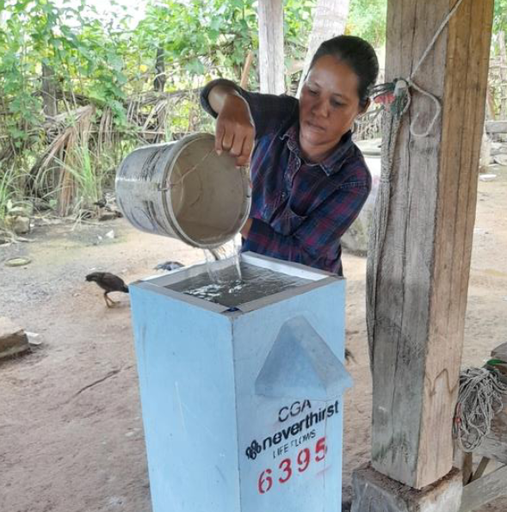
Presentation - The Case for Household Water Treatment
Recent reports from the World Health Organization (WHO), the WHO-UNICEF Joint Monitoring Programme (JMP), and United Nations (UN) Water show that safely managed drinking water is not on track globally to achieve Sustainable Development Goal (SDG) 6.1: universal access to safely managed drinking water.
Water quality often declines between source and consumption due to contamination during transport, storage, and handling.
Drawing on these reports, this presentation summarizes an evidence brief and highlights household water treatment and safe storage (HWTS) as a proven, complementary approach to protecting drinking water quality at the point of use.
Presentation - The Case for Household Water Treatment
Recent reports from the World Health Organization (WHO), the WHO-UNICEF Joint Monitoring Programme (JMP), and United Nations (UN) Water show that safely managed drinking water is not on track globally to achieve Sustainable Development Goal (SDG) 6.1: universal access to safely managed drinking water.
Water quality often declines between source and consumption due to contamination during transport, storage, and handling.
Drawing on these reports, this presentation summarizes an evidence brief and highlights household water treatment and safe storage (HWTS) as a proven, complementary approach to protecting drinking water quality at the point of use.
Sélectionner une langue
Sélectionner un format
Durée
1 h 0 min
Besoin d'aide ?
Vous ne trouvez pas ce que vous recherchez ? Vous avez d'autres questions sur un sujet précis ? Vous avez besoin de conseils sur l'utilisation d'une ressource ? Discuter avec un conseiller de CAWST.
Contactez-nousÀ propos de CAWST
CAWST est une organisation caritative et une société d'ingénierie canadienne. Nous répondons au besoin mondial en eau potable et en assainissement en développant les connaissances et les compétences à un niveau local, afin que les personnes concernées puissent elles-mêmes mettre en œuvre des solutions à domicile.